Learning Piano As An Adult: Why It’s More Doable Than You Think
Cover image: Handmrts
My cousin picked up the piano at 41.
She’d been saying “maybe someday” for about fifteen years before she finally just did it.
Her first few months were rough — she’d text me photos of her hand positions, asking if they looked right. But two years later, she plays things I genuinely couldn’t do.
I think about her whenever someone tells me they’re too old to start. The science doesn’t back that up. The brain keeps building new connections well past the age most people assume it stops. If you’ve been sitting on this idea for a while, finding a good piano teacher is a lot more straightforward than it used to be. A quick search will get you there.
The resources now, compared to even ten years ago, are kind of ridiculous. Weekly lessons used to be basically the only option. Now you’ve got YouTube tutorials for every piece imaginable, apps that listen to you play and tell you where you went wrong, online teachers in different time zones, and whole communities of adults learning the same beginner pieces you are.
You can practice at midnight in your kitchen. That changes things. A lot of the old excuses genuinely don’t apply anymore.
One thing people underestimate is why adults actually learn. Kids get put in lessons. Adults choose to be there — nobody made you do this, nobody’s grading you, there’s no recital you have to survive. You’re doing it because some part of you genuinely wanted to. That turns out to matter a lot for how long you stick with something when it gets frustrating, which it will.
What the science actually says about learning music later in life
For a long time, the assumption was that the brain was basically locked in after childhood.
A lot of people still believe this — maybe you do too. It sounds logical enough. But it’s not quite what the research shows.
Neuroscientists have spent decades mapping what happens to the brain during skill acquisition in adults, and the short version is: quite a lot.
Piano is particularly interesting to study because of how many different things it demands simultaneously — fine motor control, pattern recognition, auditory processing, memory, and coordination between both hands. Each of those demand triggers changes in a different part of the brain.
Most adult beginners describe pretty much the same experience early on — confused, a bit defeated, weirdly hooked. The first few weeks involve a lot of stopping mid-phrase and starting again. Then at some point, without quite knowing when it happened, things start to feel less impossible. A passage you’ve played badly thirty times in a row suddenly works. That moment is real, and it’s what keeps people going.
Adults also bring things to the process that kids genuinely don’t have. More patience, usually. A more realistic sense of how long things take to learn. You’ve already figured out, through years of other things, that you have to put the hours in before something clicks. A nine-year-old hasn’t worked that out yet. You might not pick up the physical technique as quickly — that part is real — but the mindset side of learning is often stronger.
The other thing adults tend to do differently is how they handle mistakes. A kid will just play the wrong note again and again, hoping something changes. Adults are more likely to stop and actually think — okay, where exactly did that fall apart? Was it the left-hand timing? Did I rush the transition? That habit of pausing to diagnose rather than just repeating ends up saving a lot of time.
What’s actually happening in your brain when you practice
Neuroplasticity: what it means in plain terms
Brain imaging has revolutionized the way we think about learning in adults.
With MRI technology, they can watch specific regions activate and grow denser connections during musical practice. The motor cortex changes. The auditory cortex changes. Even the corpus callosum — the bridge between the two brain hemispheres — tends to develop in people who play piano regularly. These aren’t small or theoretical changes. They’re measurable, documented, and they happen in adults.
You notice it from the inside too, even without a brain scan.
Week one: everything feels wrong. Your fingers won’t go where you tell them. Reading the notes while trying to think about your hands at the same time seems physically impossible. Then, a few weeks in, something loosens up. The notes start making more sense. Your hands start doing things without you having to consciously direct every single movement. It’s not sudden — it sneaks up on you.
So which parts of the brain actually change?
The changes show up across several different systems — not just one:
- Motor cortex: controls fine motor movement; it’s what eventually lets your fingers find the right keys without you having to think about it
- Auditory cortex: people who practise regularly start hearing music differently— picking up on things like timing and pitch variation that they’d have tuned out before
- Memory systems: holding a whole piece in your head while playing it is one of the more demanding memory tasks most adults ever do
- Sensorimotor connections: the coordination between hearing something and physically responding to it — this builds slowly but noticeably
None of this stays isolated to music, either.
The regulars have also observed circumstances in which it becomes relatively easy for them to concentrate while working, learn languages, and become mentally sharp in general. There may not be much causal evidence for this phenomenon, but the correlation is quite clear to warrant further research.
The benefits that go beyond just playing music
Coordination and memory
In most everyday tasks, your hands basically do the same thing at the same time.
Piano breaks that completely — your left hand is doing something totally different from your right, simultaneously, while you’re also reading ahead on the page and listening to whether what you just played was right. It’s a lot to ask at first. But the hand coordination that builds from that practice genuinely transfers. People notice it in other areas — typing faster, drawing, even cooking.
Memory comes up a lot, too.
Learning a piece by heart means holding a long sequence of movements, sounds, and timing cues in your head all at once — that’s a genuine workout for the memory systems. Whether that directly translates to remembering where you left your keys is harder to say, but a lot of adult learners bring it up unprompted.
Other things that tend to improve
A couple of additional areas that tend to arise during such discussions include:
- Multitasking: piano performance is multitasking with music – both hands are working along with rhythm, dynamics, and reading
- Short and long-term memory: the recall you build learning pieces by heart seems to carry over in ways that are hard to ignore
- Focus: sitting with a difficult passage and not giving up on it trains something that doomscrolling definitely doesn’t
Then there’s the stress thing, which I didn’t expect to be as significant as it apparently is.
Playing — even badly, even something you’ve been struggling with for weeks —seems to create a kind of forced presence. You physically cannot be running through tomorrow’s to-do list while your hands are trying to navigate a tricky passage. It takes over just enough of your attention to give the rest of your brain a break. I’ve heard people describe it as the only time in their day when they’re fully somewhere.
The real obstacles — and how to deal with them
Time is the obvious one, and I’m not going to pretend it isn’t a real problem. Most adults are already stretched. But the actual amount of practice time you need is probably less than you think. Fifteen or twenty minutes a day will move you forward faster than a two-hour session once a week — that’s not motivational fluff, it’s just how the brain consolidates new motor skills. Sleep between sessions matters. Spacing matters. You don’t need big blocks of time; you need regular ones.
The harder one, honestly, is the ego problem.
Adults aren’t used to being genuinely bad at things. We all go about our daily lives with the knowledge of what we’re doing – whether we’re at school, at home, or at work. Getting onto a piano and coming up with music that sounds like a cat going over the keys can be daunting – in ways that aren’t necessarily easy to anticipate. For some, it might feel liberating. For others, it can be torture. There’s really no other way than to stick with it until it starts to sound like something.
Getting started: what actually helps
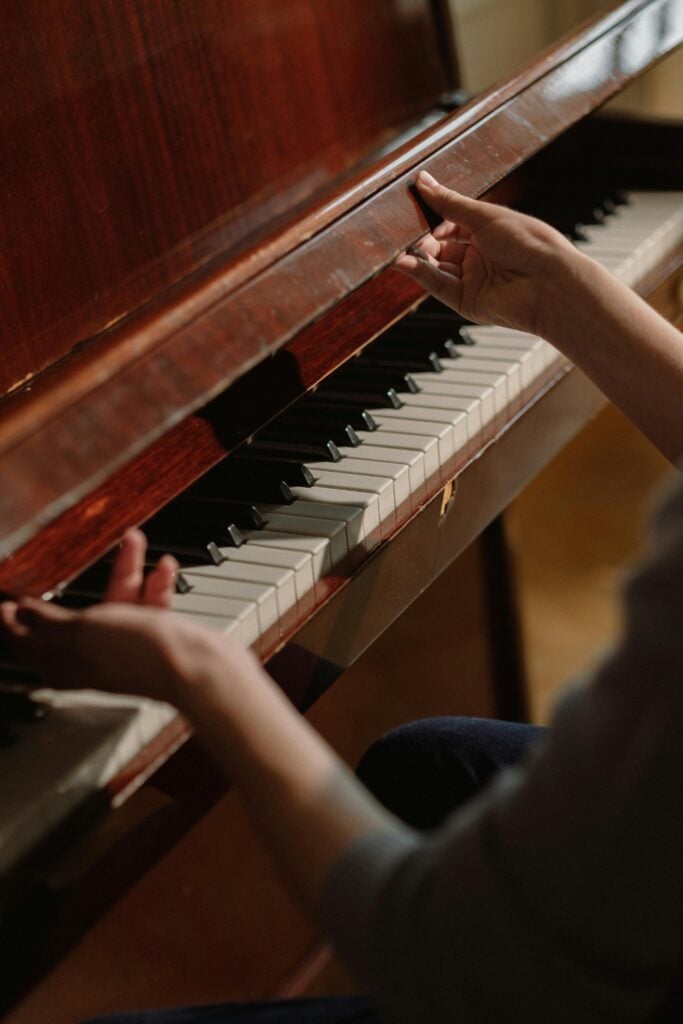
Image: Cottonbro Studio
I believe that if you have stuck with it, you’d agree that the first month was the toughest. Getting through that period is mostly about not quitting when it’s uncomfortable. A teacher helps enormously here — not because they have magic insights, but because having a structured session each week creates accountability, and because they can catch the bad habits early, before they get locked in. Bad technique that goes uncorrected for six months is much harder to fix than bad technique caught in week two.
On equipment: don’t let the instrument question stall you. A digital keyboard with weighted keys is perfectly fine for learning and costs a fraction of an acoustic piano. The more important variable is location. If it’s easy to get to — in the living room, somewhere you walk past — you’ll play it more. If it’s folded up in a corner of a spare room, you won’t. Accessibility beats quality at this stage.
If there’s one practical thing to take from all of this: play a little every day rather than a lot once a week. Your brain needs sleep between sessions to lock in what you practiced. A single long session on the weekend doesn’t give it that. Daily short sessions do. Even ten minutes counts.
The mindset piece
Those who excel at this share a few traits, including the ability to approach the challenge from the perspective of solving a puzzle rather than performing for an audience.
The problem-solving attitude is more important than proving a point; when faced with obstacles, they become a skill, it’s actually quite distinct from most conventional approaches to education, intrigued rather than discouraged.
While it may seem like an obvious concept, there’s a lot of talk about “growth mindset” that gets thrown around a lot, to the point where it’s lost most of its meaning. But the underlying idea — that skill comes from practice, not from being born talented — is genuinely relevant here. Piano ability is not fixed. Everyone who’s ever played well at any level got there by working through a lot of bad playing first. That’s not inspirational filler. It’s just how it works.
It’s not too late — and it probably never was
The “window” idea is worth retiring. There’s no evidence for a hard cutoff after which learning piano stops being possible or worth doing.
What the evidence does show is that consistent practice produces real change in the adult brain — in motor function, memory, and attention — and that adults bring genuine advantages to the process. Whether you want to play one piece for yourself in the kitchen or something more ambitious eventually, the starting point is the same: you just have to start.
My cousin is working on Chopin now. Nothing complicated, but something she genuinely likes. She still texts me about it. There’s no age this stops being available to you — the curiosity, the frustration, the satisfaction of finally getting something right. None of that has an expiration date.