
What is Headphone Impedance? [Definitive Guide]
This is part 1 in a series on Headphones and Their Drivers.
- What is Headphone Impedance? (You are here)
- What is Sensitivity in Headphones?
- What is Output Impedance?
- What is a Headphone Driver?
What is a Planar Magnetic Driver?
Hi friend and Welcome!
What is Headphone Impedance? That’s quite a fully loaded question, but a good one nonetheless. Before we get into it, grab a snack, sit back and relax because…
You’ve come to the right place!!
Make sure to pin this Infographic if it helped you, and/or you think it would help someone else!

Introduction
You may have been shopping for headphones and come across the dreaded impedance rating.
Most of the time, you wouldn’t give it a second thought with low-budget headphones because it doesn’t really matter that much.
Pretty much all of those cans are meant to be used with portable devices, and buyers won’t even consider an amplifier because they either:
- Don’t know what it is.
- Don’t care.
- Know they won’t need one.
While most lower-budget headphones don’t require an amp and don’t benefit from one, there are a few exceptions.
The AKG K240 Studio is a prime example.
At 55 Ohms and 91dB of Sensitivity, they absolutely require an amp because they’re woefully inefficient.
- Related: What is Sensitivity in Headphones?
They don’t sound that great plugged into a phone or laptop, but once you pair them with an amp that provides enough juice, boy howdy do they sound amazing.
The mid-range especially opens up, and you realize why they’ve been a studio standard for so long.
But what is headphone impedance exactly?
What is Headphone Impedance?
To understand this concept, we first must differentiate between 3 terms that people sometimes mistakenly use interchangeably when discussing Impedance.
These terms are Voltage, Current, and Power.
Voltage
Definition: The difference in electrical potential energy, per unit of charge, between two points.
Voltage is measured in volts, obviously.
In layman’s terms, Voltage is simply a measure of the potential energy that a headphone amplifier has. It doesn’t actually represent movement and is static.
Think of a battery. It has a potential voltage associated with it, even if it’s not connected to a circuit.
The potential is the difference between the 2 terminals on the battery, and that difference is equal to 9 volts (or however many volts the battery has).
Now think of a headphone amplifier.
If I have an amp sitting on my desk but I’m not using it, there’s still the potential for energy there, even though it’s not doing any work.
I think you get the idea.
Current
Measured in amps.
Current is a measurement of the flow of electrons passing a certain point.
To use an analogy, imagine 2 cups of water.
There’s the potential for energy there, but nothing has happened yet.
Current is simply the transfer of water from one cup into the other.
So, current is a measure of the flow (or movement) of electrons from one unit to another.
Before we move on, there’s an important clarification.
When we talk about current as the “flow of electrons,” that’s a helpful beginner analogy — but in audio circuits, the signal is alternating current (AC). That means the voltage is constantly switching polarity, typically between 20 and 20,000 times per second (20 Hz–20 kHz). The electrons themselves don’t travel from your amp all the way into your headphones and stay there. Instead, they oscillate back and forth very rapidly.
What actually moves through the circuit is energy.
So while it’s fine to picture current as “flow,” it’s more accurate to think of it as energy being transferred through oscillating charge. The headphones aren’t being “fed” a one-way stream of electricity — they’re responding to a rapidly changing signal that moves back and forth.
This matters because it sets up why impedance is more than just simple resistance.
Power
Measured in Watts, or joules per second.
Power is simply the combination of both the potential energy (Voltage) and the transfer, or flow, of energy (Current).
So Current x Voltage. It’s a function of energy over time, or energy per second.
So imagine there’s a paddlewheel between the 2 glasses of water as you’re pouring one into another. The combination of both voltage and current = the Power that makes the wheel turn; i.e. do some sort of work.
Now that we understand each term on its own, let’s see how it applies to headphones.
Definition of Impedance
The definition is as follows: The combined resistance and reactivity that the headphones present to the amp as an electrical load.
It’s basically a measure of how your earphones or headphones interact with that electric current we just talked about (or more specifically, a changing current).
When you have a headphone with a high impedance, it doesn’t mean it “doesn’t want to play loud.” It simply means that for a given voltage, less current will flow compared to a lower-impedance headphone.
And since electrical power depends on both voltage and current:
…a higher impedance headphone will receive less power at the same voltage level.
Now here’s the important part: loudness isn’t determined by impedance alone. It’s determined by sensitivity — how efficiently the electrical power is converted into sound.
So when you use an amp with enough voltage swing, you’re not “forcing” power into the headphones. The amp applies voltage, the headphone’s impedance determines how much current flows, and that relationship determines the power delivered.
If the amp can supply enough voltage cleanly, the headphones will reach their intended listening level — no drama required.
Earlier, we mentioned that impedance is resistance plus “reactivity.” That word is extremely important.
Because audio is AC and not DC, the electrical load a headphone presents to an amplifier changes depending on frequency. Components inside the driver — primarily the voice coil (which has inductance) — respond differently at different frequencies.
That means impedance is frequency dependent.
When a headphone is labeled “300 Ohms,” that number is not a constant across all frequencies. It’s a nominal rating measured at a specific frequency (often 1 kHz). At other frequencies, the actual impedance may be higher or lower.
This is the key difference between resistance (a static DC value) and impedance (an AC value that varies with frequency).
Low Impedance vs. High Impedance
When discussing varying impedances, generally speaking:
Low Impedance = between 16 and 32 Ohms.
This range works well with portable music players, phones, and other similar devices with weaker built-in amplification.
Low impedance headphones are more prone to blowouts when using a powerful amp, but can still sometimes benefit from one.
High Impedance = Over 100 Ohms.
These require more power (discussed above) to achieve higher audio levels.
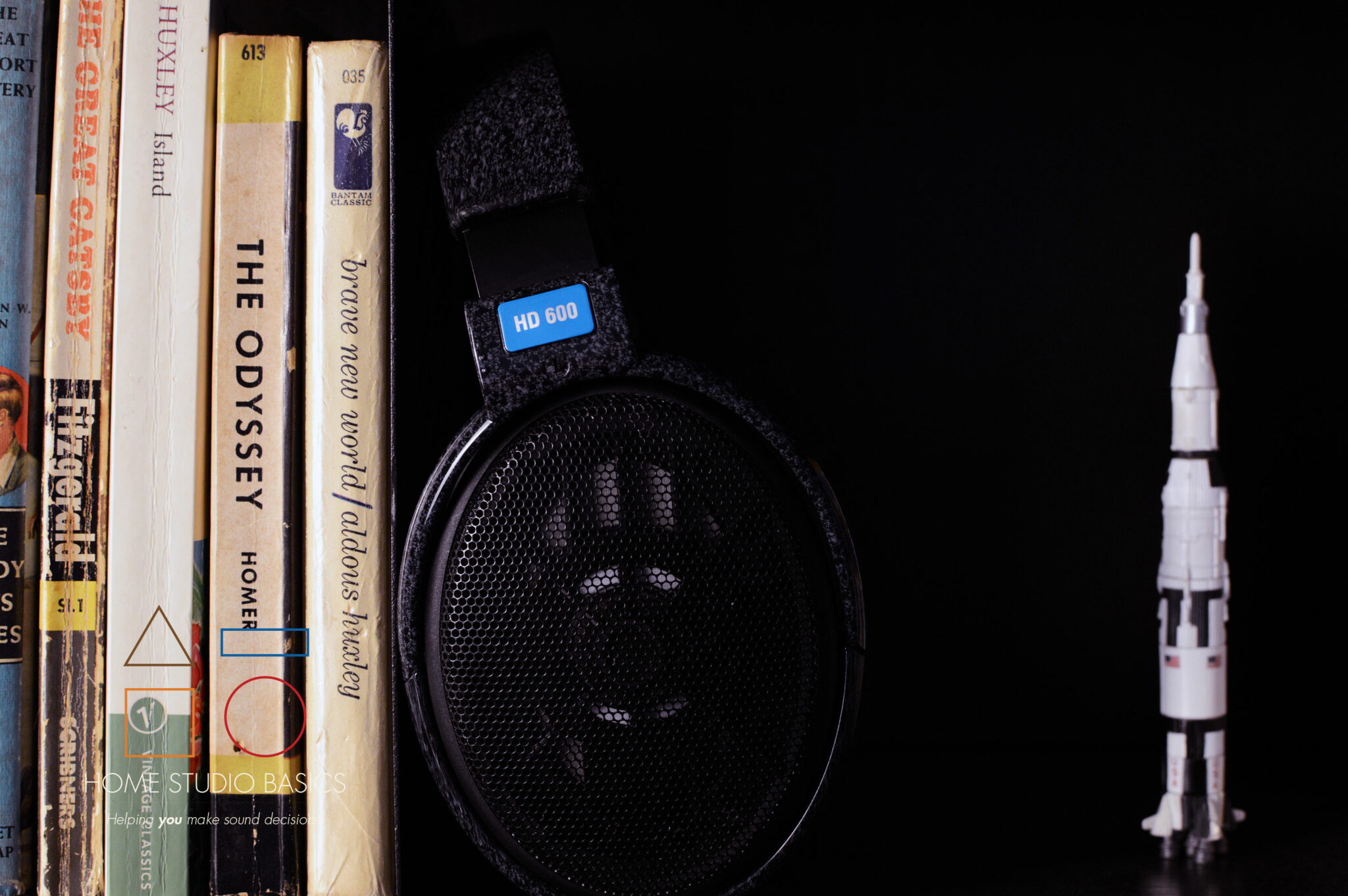
A good example would be the beloved Sennheiser HD600.
Headphones like this are both protected from the damage that occurs with blowouts and can be used with an array of audio equipment.
For instance, pairing an HD600 with an old receiver can yield an incredibly good sound depending on the unit in question due to Output Impedance (which we’ll touch on later).
Gray Area = 32 – 100 Ohms.
Headphones in the gray area may or may not benefit from an amp. It just depends.
If you have a headphone with an Impedance rating in this region, take a look at the Sensitivity to get a better idea about its power requirements.
An AKG K240 (62 Ohm Impedance) is a great example at 91dB Sensitivity, meaning it’s terribly inefficient and needs quite a bit of power from an amp to reach acceptable listening levels.
You’ll often hear people say that high-impedance headphones are “harder to drive” or “need more power.”
That statement is shorthand — and it can be misleading if we don’t explain why.
Most headphone amplifiers are voltage-limited devices. The volume knob increases voltage. The power delivered to a load depends on both voltage and impedance.
If you hold voltage constant, a lower impedance headphone will draw more current and therefore more power. A higher impedance headphone will draw less current and therefore less power at that same voltage setting.
That’s why, at the same position on a volume dial, a 32-ohm headphone may receive significantly more power than a 300-ohm headphone.
However — and this is important — loudness is not determined by impedance alone.
The real predictor of how loud a headphone will get is sensitivity.
What is Sensitivity?
Sensitivity is one of the most misunderstood concepts in the audiophile world.
It is simply a measurement of how efficiently a headphone converts electrical energy into sound.
Manufacturers usually express it as:
- dB SPL per milliwatt (dB/mW)
- or dB SPL at 1 Volt (dB/V)
A headphone rated above 100 dB is considered efficient and will require less power to reach high listening levels (around 110 dB SPL).
A headphone rated 97 dB or lower is less efficient and will require significantly more power to reach the same volume.
It tells you how much sound pressure level (SPL) the headphone produces at a given voltage (for example, dB SPL at 1 Volt) or at a given power level (for example, dB SPL per milliwatt).
Two headphones with the same impedance can have very different sensitivities. Two headphones with very different impedances can get equally loud from the same source if their sensitivities differ.
So impedance does not mean a headphone “doesn’t want to get loud.” It simply tells you how the voltage and current will relate electrically. Sensitivity tells you how efficiently electrical energy is converted into acoustic output.
Examples
- In-ear headphones or earphones. Good efficiency/high sensitivity. Rarely needs an amp in most cases.
- Noise-canceling headphones. Do not need an amp because there’s a built-in one already. Related: How Do Noise-Canceling Headphones Work?
- An amp with a DAC (Digital to Analog Converter) will improve your listening experience because there is better digital-to-analog conversion and processing power.
One more nuance worth understanding: in audio, power isn’t a constant DC value moving in one direction. The signal is alternating.
The voltage swings positive and negative thousands of times per second, and the driver responds by moving back and forth, creating pressure changes in air. Power delivery depends on the instantaneous voltage and current at any given moment in the waveform.
So when amplifier specs list “milliwatts into X ohms,” that’s based on standardized test conditions (usually a sine wave at a specific frequency). Real music is more complex.
That doesn’t make the specs useless — it just means they’re approximations of real-world behavior.
What is a DAC?
(And do you need one?)
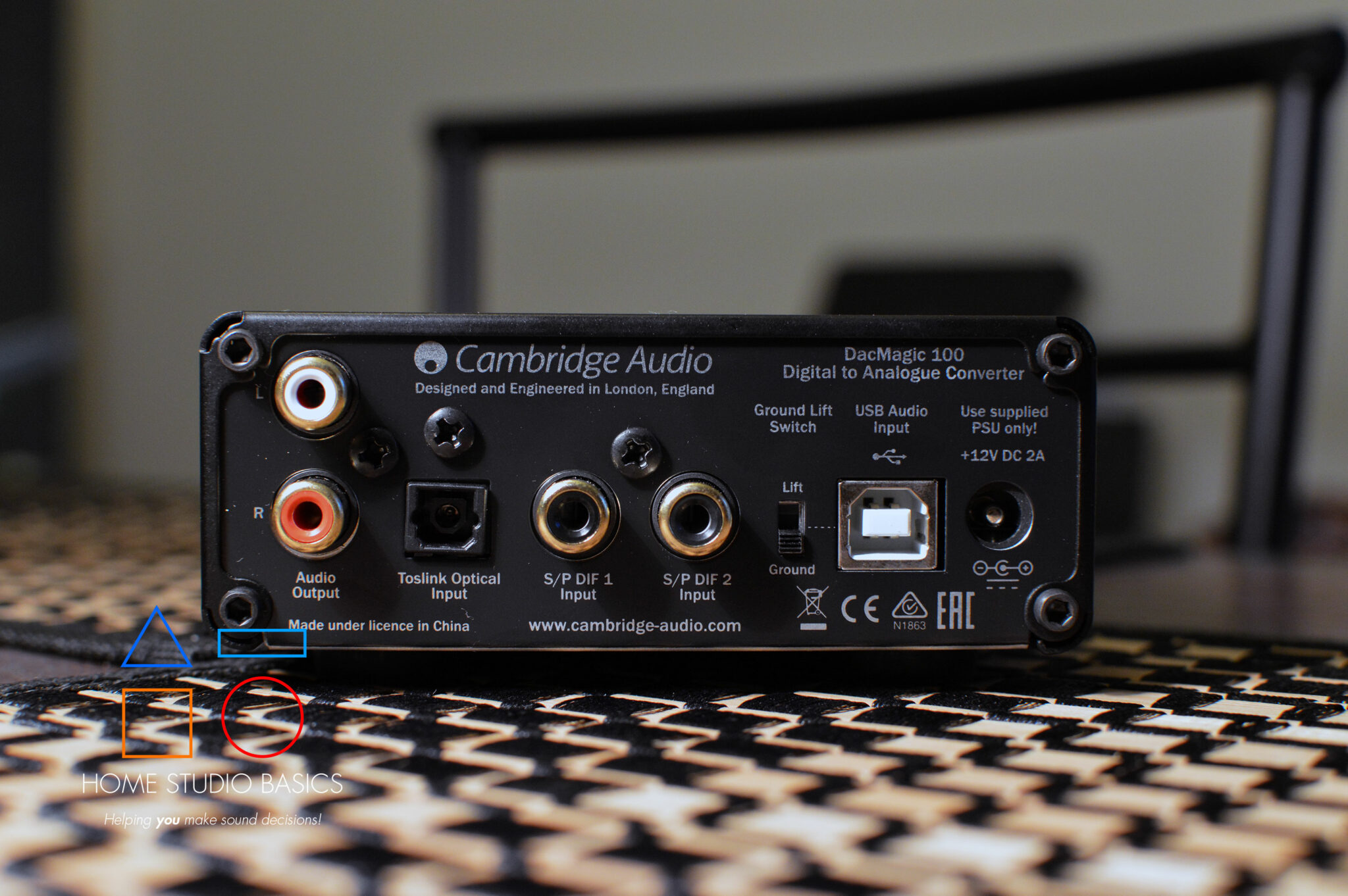
In layman’s terms, a DAC is a Digital to Analog Converter.
It converts the 1s and 0s from your computer (the digital realm) into the analog sound that you hear and vice versa.
In the recording, you scream curse words (analog/your voice) into the microphone, and your computer makes sense out of it digitally for you to edit and EQ later.
- Related: What is a USB DAC?
There’s also an internal DAC in your phone, mobile device, and pretty much anything that outputs sound.
Your PC has an internal Soundcard that functions in the same way.
- Related: What is a Soundcard?
All that said, only invest in a DAC if your Soundcard or existing DAC is no good. You’ll know because the sound will either:
- Not be loud enough.
- Sound like poo.
- Make lots of unnecessary noise/crackling, etc.
For instance, my old laptop’s internal Soundcard didn’t output at a listenable level.
For me to achieve the loudness that I’m looking for, some sort of upgrade is required.
Power Output Examples

As an example, a headphone like the 300 Ohm HD600 requires 20mW of power to perform optimally.
The Schiit Magni 2 provides 260mW of power into 300 Ohms.
You can see why it’s such a valuable piece of equipment.
It can effectively power nearly any headphone, and in reality, provides much more than is needed in most cases.
The takeaway here is to simply make sure the power output of the Amp in question is sufficient for the headphones’ Impedance.
You can do this by checking out the specifications of the amp, as most spec sheets will give a rundown of how much power each Ohm rating can receive.
One important thing to keep in mind is the difference between peak power and continuous.
RMS (Root Mean Square), is the amount of power that can be used from your Amplifier continuously; that is, it’s the power it can provide while you’re listening to music at normal volumes.
Peak power specifies how much power the Amplifier can provide to the headphone in short bursts, or the absolute highest amount of power without experiencing distortion, or before something explodes.
In essence, peak power is useless as you’d never be able to run headphones off it for more than a few seconds.
So be wary of what numbers you’re actually seeing when looking at a manufacturer’s spec sheet.
For something like the Magni 3, the numbers are as follows:
- Maximum Power, 16 ohms: 3W RMS per channel
- Maximum Power, 32 ohms: 2W RMS per channel
- Maximum Power, 50 ohms: 1.3W RMS per channel
- Maximum Power, 300 ohms: 430mW RMS per channel
- Maximum Power, 600 ohms: 230mW RMS per channel
Notice how Schiit makes this clear by adding RMS (continuous) at the end.
The Objective 2 is similar. Let’s take a look.
- Max Output (33 Ohms): 613 mW
- Max Output (150 Ohms): 355 mW
- Max Output (600 Ohms): 88 mW.
These numbers also look to be RMS, but I think you get the idea.
An amp’s spec sheet is one of the best tools at your disposal.
If a company doesn’t share this info, I’d probably not even consider purchasing the amp. Fortunately, most do!
Output Impedance

This is the impedance of the actual source you’re using, which can be difficult to find sometimes.
A perfect source = an output impedance of 0. This means it will always deliver the same output into any load (headphone). This is probably the most important thing to remember.
The closer to zero the number is, the more neutral and honest the representation of the headphone’s sound signature will be.
A number in this range basically means that the Amp will be as consistent as possible with the largest number of headphones.
You could theoretically buy one of the amps mentioned above from Schiit or JDS Labs and be set for life.
Unfortunately, if you’re a snobby audiophile, you’ll want to explore as many options as possible.
When output impedance is high relative to headphone impedance, the voltage seen by the headphones becomes frequency‑dependent, which can alter the perceived frequency response.
So in a nutshell, the higher the output impedance, the greater the drop in voltage at the load.
Do keep in mind that this doesn’t necessarily mean the amp is bad if it has a higher output impedance.
Many people enjoy tube amps because of the fact that they don’t sound neutral and give the headphones a different flavor.
Your mileage may vary in what you personally prefer out of your listening experience.
Basically, output impedance is one of the most common reasons that certain headphones can sound different when plugged into different amps.
- Recommended: What is Output Impedance?
The Simple Math
Determine if your headphones will work with the Amp in question!
- Most headphones work best when the output impedance is less than 1/8th of the input impedance.
Example:
Sennheiser HD600 @ 300 Ohms.
300/8 = 37.5 Ohms
So the output impedance of your amp/DAC should not be greater than 37.5 ohms when driving the 600. A popular option for the HD600 is the Schiit Magni/Modi combo. The Magni has an output impedance of less than 0.1 Ohm. This is the reason that it’s such a versatile amp. Remember what we said about a perfect source? As close to zero as possible.
- Related: How to choose a headphone amp!
If you have a source with a high output impedance, it’s more likely that there will be a discrepancy in the way your headphones receive the sound. This can manifest erratically depending on the headphone.
A good rule of thumb is to try to match high impedance headphones with high output impedance sources if possible. An example would be an old receiver. The way your [high impedance] headphones sound through it can vary greatly depending on the model of the receiver in question.
The greater the output impedance, the more likely the bass response will be affected in a negative way. For instance, if the bass frequency was meant to sound tight and controlled with impact, it may actually sound muddy and/or boomy/bloomy (less controlled).
The bass will start to “roll-off” sooner at lower frequencies, compromising your listening experience.
Closing Thoughts
It’s rather important to take these things into consideration; especially the power output of the amp in question and the 1/8th rule.
Why? Because if the output impedance is greater than 1/8th of the headphone impedance, there will be undesirable variations in frequency response.
Examples:
- Weaker bass
- Glaring mid-range emphasis
- Muted high frequencies
- Odd phase characteristics
Basically, this just means that the headphones will not sound as they were meant to. So be careful what you’re plugging those bad boys into! 🙂
Example:
My Audio Technica ATH-M50 has an impedance of 38 Ohms. My Scarlett 2i2 had an output impedance of fewer than 10 Ohms. Now, this is a bit tricky:
38/8 = 4.75
The output impedance (10 or thereabouts) is greater than 1/8th of the headphone impedance. So will the M50s sound bad plugged into the 2i2?
Not necessarily, at least not to my ears, but they may not be at their best. The only way to find out is if I bought a separate amp/DAC and compared them. To my ears, they sound pretty blazin’ though 😛
The point is this: Just be aware of what you’re buying as far as amps are concerned.
I didn’t buy the 2i2 to amplify the M50. I bought it to power my studio monitors.
Regardless, using the 1/8th rule will greatly aid you on your quest.
- Related: What are studio monitors?
With that…
My top option for a headphone around the threshold of 97dB and a higher Impedance (300 Ohm) is, of course, my beloved HD600.
Interested in learning more about one of my favorite audiophile cans?
My top option for a higher Sensitivity headphone and lower Impedance model that doesn’t need a lot of power is most certainly the Sony MDR-7506 @ 106dB and 63 Ohm.
It’s been a quintessential studio headphone for decades and is certainly worth a look.
Well, that’s about it for today my friend! I hope I answered the question of, what is headphone impedance?
Did I provide enough information? Are you confused? Enlightened? Appreciative? Let me know!
Questions? Comments? Requests? Did I miss the mark on something? Please let me know down below or Contact me!!
If you love what I do here and want to support the blog and channel in a more personal way, check me out on Patreon and discover all the value I have to offer you.
Just want to make a one-time donation? Click here. Your support is greatly appreciated and helps keep this site running!
All the best and God bless,

-Stu
Can’t decide which headphones to purchase? Interested in a complete buyers guide outlining over 40 of the best options on the market? Click on over to the best audiophile headphones to learn more!!
Be sure to also check out my Reviews and Resources page for more helpful and informative articles!



Thanks man, I really needed some tutorial like this. Great work
Could you explain why the coefficient is 1/8? Is there any science behind that or it’s just an experienced number?
Hey man! Thank you so much!
Since I wrote this, I mostly just use Sensitivity (or efficiency) as my main barometer, and then Impedance second. I have enough experience with headphones and Amps to kind of intuitively know how one might behave with any given product. Sensitivity is, to me, a better indicator of how much power a headphone is going to need from an amp, but Impedance is still very important.
Check my article on Sensitivity. Are you looking for a pair of headphones w/ an amp/dac?
As for the 1/8th rule, it’s basically just a general figure put in place to minimize frequency response abnormalities that may manifest when you’re dealing with Amplifiers that have a higher output impedance (basically an unpredictability in how a headphone might sound out of such an amp).
Now, that’s not to say that high output impedance is bad; quite the contrary. It just means you have to be more mindful when it comes to pairing a headphone with an amp that introduces that sort of resonance and/or distortion. Higher impedance headphones generally sound excellent out of these. For instance a Bottlehead Crack has an output impedance of 120 Ohms and should really only be paired with something like an HD600/650 (300 Ohm), or some other headphone with a very high impedance.
Put more simply, problems will start to arise anytime the output impedance is more than the headphone’s impedance, i.e. you should pretty much never try to run a 32 Ohm headphone out of a Crack (see how the ratio is reversed at 1/4?). This goes back to the 1/8th rule and why it’s still pretty important. 8/1 gives you just about the best control with regard to smoothness, dynamics, timbre, (pretty much everything that effects how well the music is portrayed), though a ratio 4/1 still works too.
Another consideration to keep in mind is damping, because as the output impedance of an amp goes up, damping is reduced in the headphones. This leads to compromises in bass response most notably, but also results in poor transient response and a general “flabbiness.” It’s also why the 1/8th rule is important as most headphones are designed much differently than they were years ago, i.e. they don’t work well with many receivers that had a high output impedance. Even with that said, a headphone like the HD600 will likely sound incredible out of such a source because of this very reason. I have an old Panasonic stereo with a high output impedance and it sounds pretty wonderful with my 600’s. 🙂
Hope that helped! Let me know what you think and if you’re looking for an amp or headphone!
-Stu
Hey man ,
I have AKG 702 with SBX G6 , should i put it on high or low gain !
I feel high is give me more loud sound and richer but they said on G6 website only put H on headphones or than 150 OHM
Hey man! I generally use high gain with the K702 and G6, as well as Scout Mode.
Thank you so much for this. I want to purchase a HD650 and was looking into how to get the whole setup done. This articles have been very helpful in understanding the basics.
Sainik,
Really appreciate the love brother! Please keep me posted with questions and if you ever need help, don’t hesitate to reach out.
-Stu
Hello,
I appreciate the idea of explaining these concepts to people searching for good headphones and amps, but I don’t really appreciate spreading the standard misconceptions of the headphone hobbyist circles.
Electrical resistance is a measure of the ratio between the voltage and the amperage. This means if something has a high resistance, the voltage will need to be higher to have the same power dissipated in the load. This also means the amperage is lower, as the power is the product of these two factors.
Voltage is, as you mentioned, the difference in energy potential. The water analogy of tanks of water with different pressures can help internalising the concept.
Amperage is not really the flow of electrons, but the flow of energy in the electrons, as no electrons actually move from potential A to B (or + and -). The water analogy works, but it is quick to misinterpret as electrons moving. Amperage is also not “pushed” through the headphones, the resistance *limits*, a really important distinction. This is irrelevant to headphones, however.
The definition of power makes sense, but in headphones, the power does not move from one end of the river to the other, it moves back and forth really quickly (about 20 to 20 000 times per second), which is what produces pressure differences in air that we can hear.
This brings me to impedance, where you quickly gloss over the really important term in the definition, “reactivity”. We already know what resistance means, but the reactivity part is there because the headphone is not presented with a signal that is direct current. This would represent a 0 Hz signal, which is outside the human range of hearing. What reactivity represents is that audio is an alternating current signal with frequencies primarily in the 20 Hz to 20 kHz range. This means the voltage changes that many times per second from positive to negative between the terminals, which also changes the flow of charge in the electrons to go from one terminal and back. Components in headphones, such as coils to move the driver, react differently to the signal depending on what frequency it is, and will then have a different “resistance” at two different frequencies. This difference from the static measure resistance, is why the term impedance exists. It is NOT the headphone saying it doesn’t want to play loud. It also means that when a headphones says it has an impedance of 300 Ohms, that is simply at one specific frequency. This enables you to get a picture of what kind of voltage you need to drive the headphones with to get the same power fed to them.
Why does this misconception, that higher impedance means you need more power exist? It is because the volume dial on an amp represents a voltage, we can imagine this is 2 V, and at that voltage a low impedance headphone of let’s say 32 Ohms, is fed V^2 / R = 2^2 V / 32 Ohms = 125 mW [https://techweb.rohm.com/product/circuit-design/electric-circuit-design/21859/]. At the same point on the dial (the same signal attenuation) a 300 Ohm headphone will receive V^2 / R = 2^2 V / 300 Ohm = 13.3 mW (A sine wave signal at the given frequency the for the indicated impedance is assumed).
This makes it sound like the same power means less audio from the headphone, but really it is the ratio between voltage and the current that means the headphone is receiving less power.
The real measure of “how loud the headphone can play” is the sensitivity that tells what sound pressure you would hear at a specific voltage (1 V). Which means the power really isn’t the problem, the sensitivity is.
I absolutely agree with the sentiment on DACs. Only buy one if you can clearly hear noise.
On the topic of “Power Output Examples”, this article does go over some of what is mentioned in this comment, but I believe the explanation of impedance shrouds what is actually meant here. A side note is that most headphones can handle about 200 mW over extended periods, your ears might not though.
The best case for output impedance I have ever heard was plugging some in-ears into my integrated speaker amplifier, which has an absurdly high impedance output. This did not sound good, but plugging into my phone was perfect. The 1/8 rule seems appropriate.
What I have explained here is not simple to understand, but the misconceptions spread through the audio community is why it took me 10 years to understand these concepts somewhat well. I hope you appreciate the sentiment of this comment and learned something. Feel free to ask me questions.
Best regards,
Magnus, MSc in Electronic Systems, specialised in Audio Signal Processing.
Magnus,
Thank you for the corrections! I’ve always told people Sensitivity is a better metric to gauge what’s going on. Really appreciate you taking the time to correct me on some of these things. I have been improving/tweaking this article quite a bit over the years and learning more, so it’s nice to have someone who knows more about it chime in. I went ahead and made the changes to reflect your points. Let me know how it looks.
Best,
-Stu